

Explanation
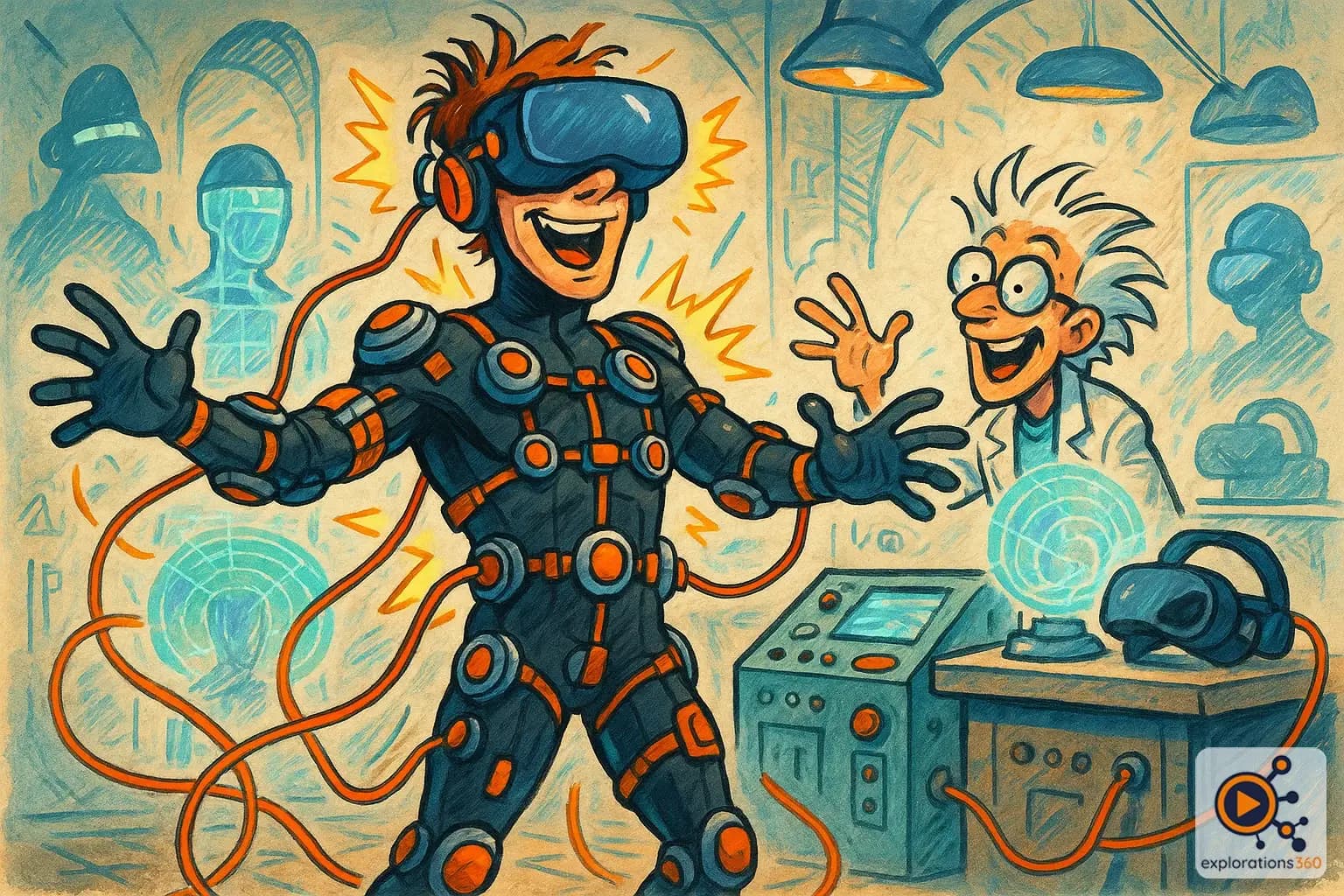
A wearable garment equipped with sensors and actuators that enables the user to interact with the virtual world through full-body tracking and haptic feedback.
Real-world example
A suit that lets you feel virtual rain on your skin or the impact of projectiles in a VR game.
Practical applications
- Full-body tracking: capturing entire body movements for avatar animation
- Full-body haptic feedback: feeling impacts, contacts, and sensations across the whole body
- Postural analysis: detecting and correcting posture during training
- Total immersion: the virtual body matches the real body
Types of suits
Tracking suits (mocap)
- IMU sensors on the limbs
- Precise body movement tracking
- Used for animation and gesture analysis
Example: Xsens, Rokoko for motion capture
Haptic suits
- Vibration or EMS actuators on the body
- Feel impacts, textures, and sensations
- For gaming and immersive simulations
Example: bHaptics TactSuit, Teslasuit
VR scenario
An athlete puts on a tracking suit to analyze their running technique. Every movement is captured: knee angle, pelvis position, arm swing. The coach visualizes the data in real time and identifies areas for improvement.
Why it matters in professional VR
- The haptic suit extends immersion beyond just the hands and head
- Niche use cases but high impact: sports, animation, rehabilitation
- Costs are decreasing: solutions like Rokoko are democratizing full-body tracking