

Explanation
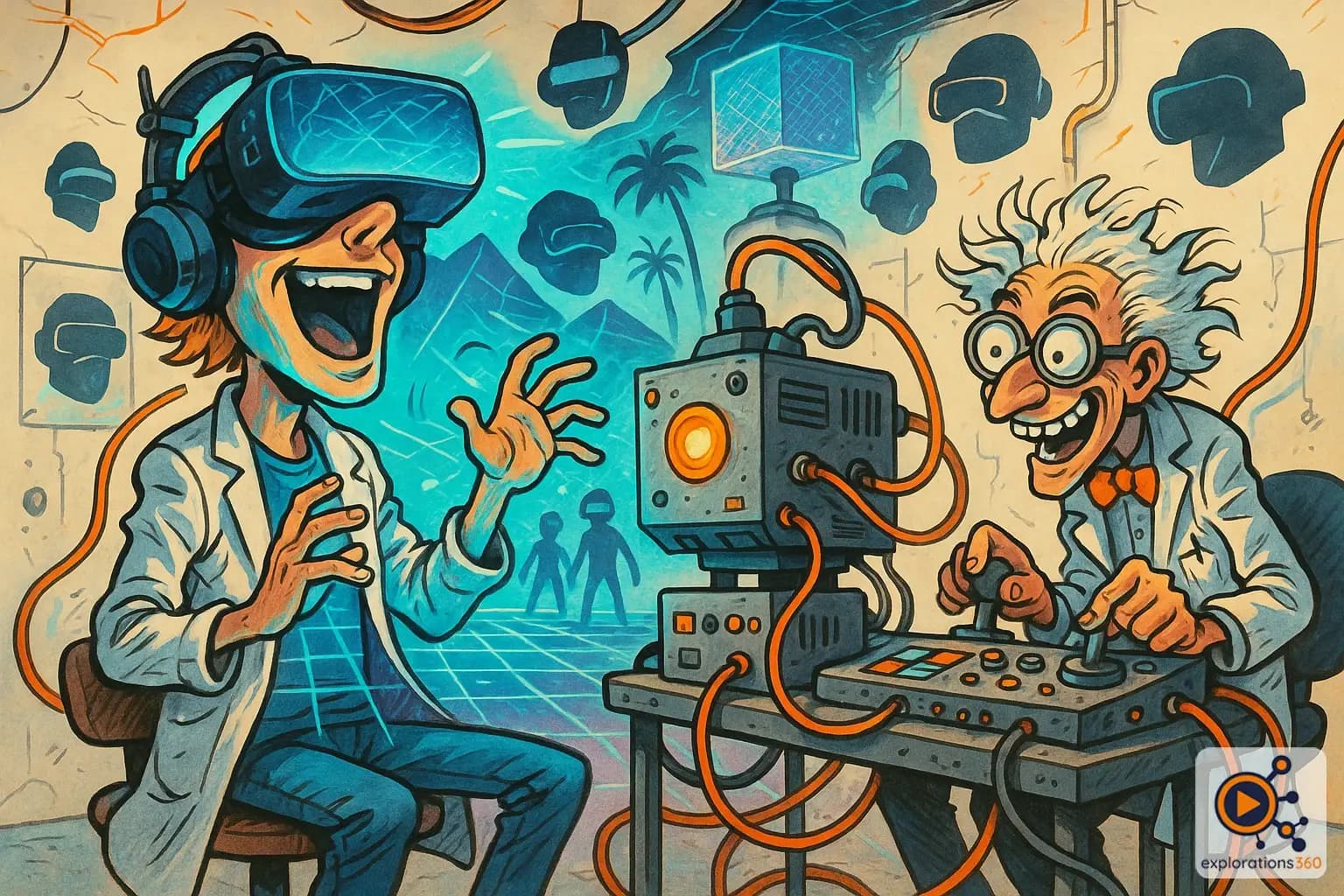
Virtual reality is a technology that immerses the user in a fully digital environment, replacing their real-world perception with a computer-generated one. Using a head-mounted display (VR headset), the user sees, hears, and sometimes feels a synthetic world that responds to their movements in real time.
Real-world example
Putting on a VR headset and finding yourself standing on a virtual beach — waves crash at your feet, seagulls fly overhead, and when you turn your head, the entire 360° environment moves with you. For a moment, your brain believes you're actually there.
Practical applications
- Professional training: safety drills, surgical practice, soft skills scenarios — all in a risk-free virtual environment
- Virtual tours: exploring real estate, heritage sites, hotels, and remote locations from anywhere
- Healthcare: pain management, phobia therapy, patient habituation, and motor rehabilitation
- Education: immersive field trips, 3D anatomy lessons, historical reconstructions
- Entertainment: gaming, fitness, social VR, and immersive cinema
Types of VR experiences
360° VR (passive)
- Real-world footage captured with 360° cameras
- The user looks around but doesn't interact with the environment
- 3DOF: rotation only, no positional tracking
- Accessible on smartphones, cardboard viewers, and any headset
Example: A 360° video tour of a luxury hotel where you look around each room
Interactive VR (active)
- Computer-generated 3D environments with full interactivity
- 6DOF: the user can move, grab, and manipulate objects
- Requires a standalone or PC-tethered VR headset
- Maximum immersion and engagement
Example: A VR fire safety training where you grab an extinguisher, pull the pin, and put out virtual flames
VR scenario
A manufacturing company uses VR to train new operators on a complex assembly line. Instead of stopping production for hands-on training, the trainee puts on a Quest 3 headset and practices the entire assembly sequence in a virtual replica of the factory. They can make mistakes, repeat steps, and build muscle memory — all without touching a real machine or slowing down production.
Why it matters in professional VR
- VR is the most immersive technology available — it uniquely enables "learning by doing" in scenarios too dangerous, expensive, or impossible to reproduce in the real world
- It transforms passive learning into active experience, dramatically improving knowledge retention and behavioral change
- VR adoption is accelerating as hardware becomes more affordable, standalone, and enterprise-ready