

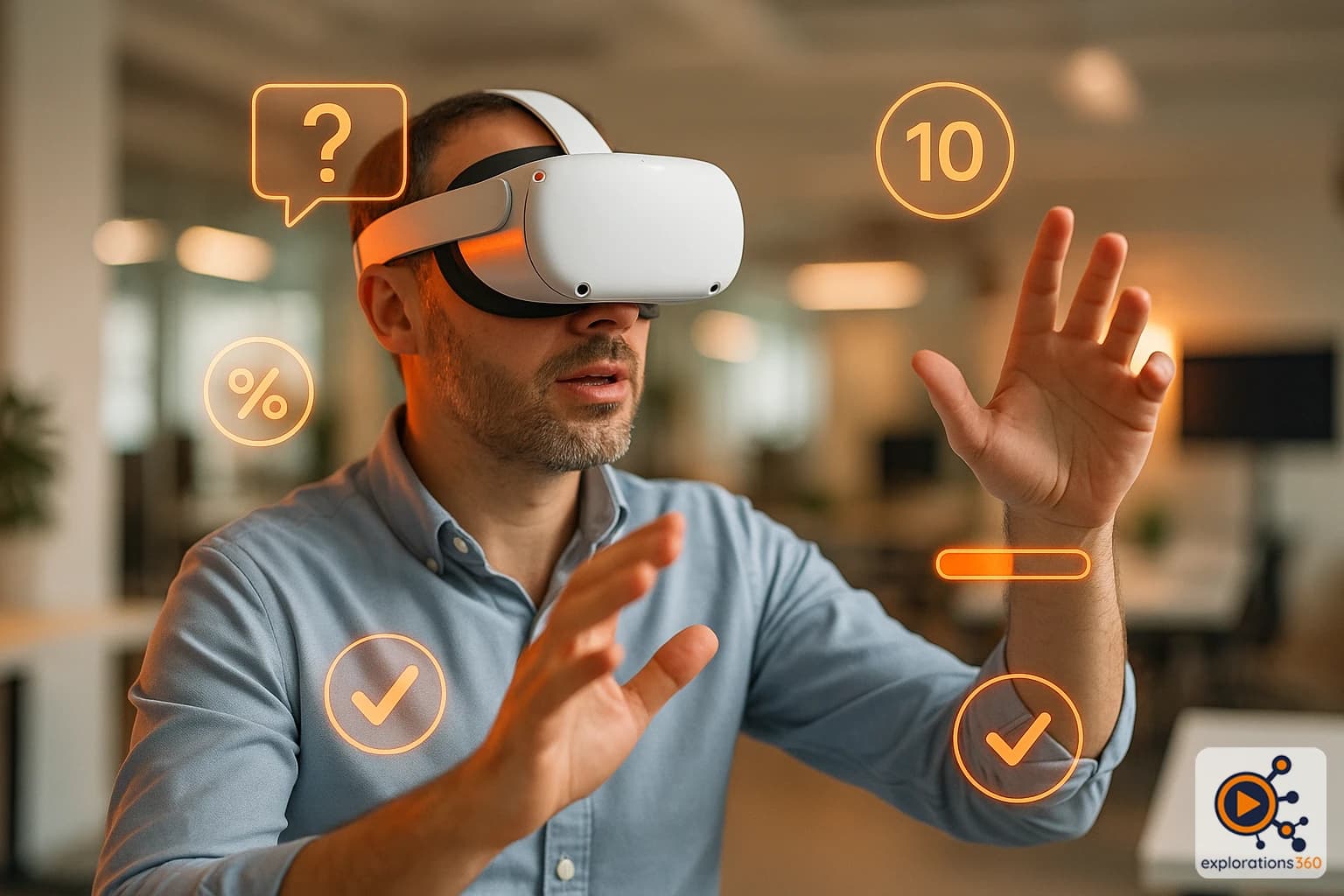
A 360° content without interaction is just a panorama. The user watches, but remains a spectator. Add game mechanics - quizzes, conditional logic, scoring - and they become an active participant in their journey. That's the whole point of immersive gamification.
In our guide on spatial storytelling, we identified adaptive narrative as the pillar that truly distinguishes a 360° experience from simple immersive content. Gamification is the practical lever: it transforms educational content into an active, measurable, and memorable learning experience.
1. Game mechanics in 360° immersion
On easystory360, four families of mechanics allow you to gamify an immersive journey, without writing a single line of code.
Conditional logic (IF / OR / AND)
Each hotspot can trigger a branch. Conditions can be combined (AND, OR) to create complex decision trees. The scenario adjusts in real time to each participant's choices.
LMS-connected integrated quizzes
Contextualized questions directly within the 360° environment - identify a risk, recognize equipment, validate a procedure. Real-time scoring, export to an LMS for tracking learning outcomes.
VR escape games
Each zone of the environment contains clues. Solving a puzzle unlocks access to the next zone. In teams, participants collaborate - effective for team building and problem solving.
Gaze-based interaction
The user focuses on an element to select it, answers a quiz by gaze. This natural interaction removes the controller barrier and makes the experience accessible to everyone.
2. Why it works: the data
The intuition that "immersion improves learning" is now confirmed by solid data. Here's what the reference studies say, detailed in our article on immersive training and retention.
What the studies say
- PwC (2020): VR learners are up to 4 times more focused. Retention rate of 75%, compared to 10% for reading and 5% for lectures.
- Transfr Inc.: one week after the session, 86% performance in VR versus 71% with slideshows. A 15-point gap that widens over time.
- International study (317 students, Salvador, 2025): +35% retention for the VR group, versus +2.6% in traditional training.
- Nightingale College (I/ITSEC 2022): +10 points on practical exams, ~40% reduction in training costs and time.
- Lindner et al. (2025) — Journal of Medical Internet Research: 30-day retention of 75.4% in VR versus 69% in video. Satisfaction: 4.83/5 in VR versus 3.44/5 in video.
- Qawqzeh et al. (2025) — Scientific Reports (Nature): 200 participants in an industrial setting. Safety awareness: +30% vs traditional training, knowledge: +25%.
- Tsukada et al. (2024) — JAMA Network Open: 90 students. VR (17.70/20) matches in-person and significantly outperforms video (15.87/20, p=0.02).
Comparative table
| Training method | Information retention |
|---|---|
| Traditional reading | 5 - 10% |
| Lecture / slideshow | 10 - 20% |
| Immersive VR training | 75 - 86% |
3. Field cases: gamification in action
The numbers take on their full meaning when confronted with real-world deployment. Here are three actual deployments that illustrate immersive gamification in professional and educational contexts.
CFMA Cooperl - Multilingual safety onboarding
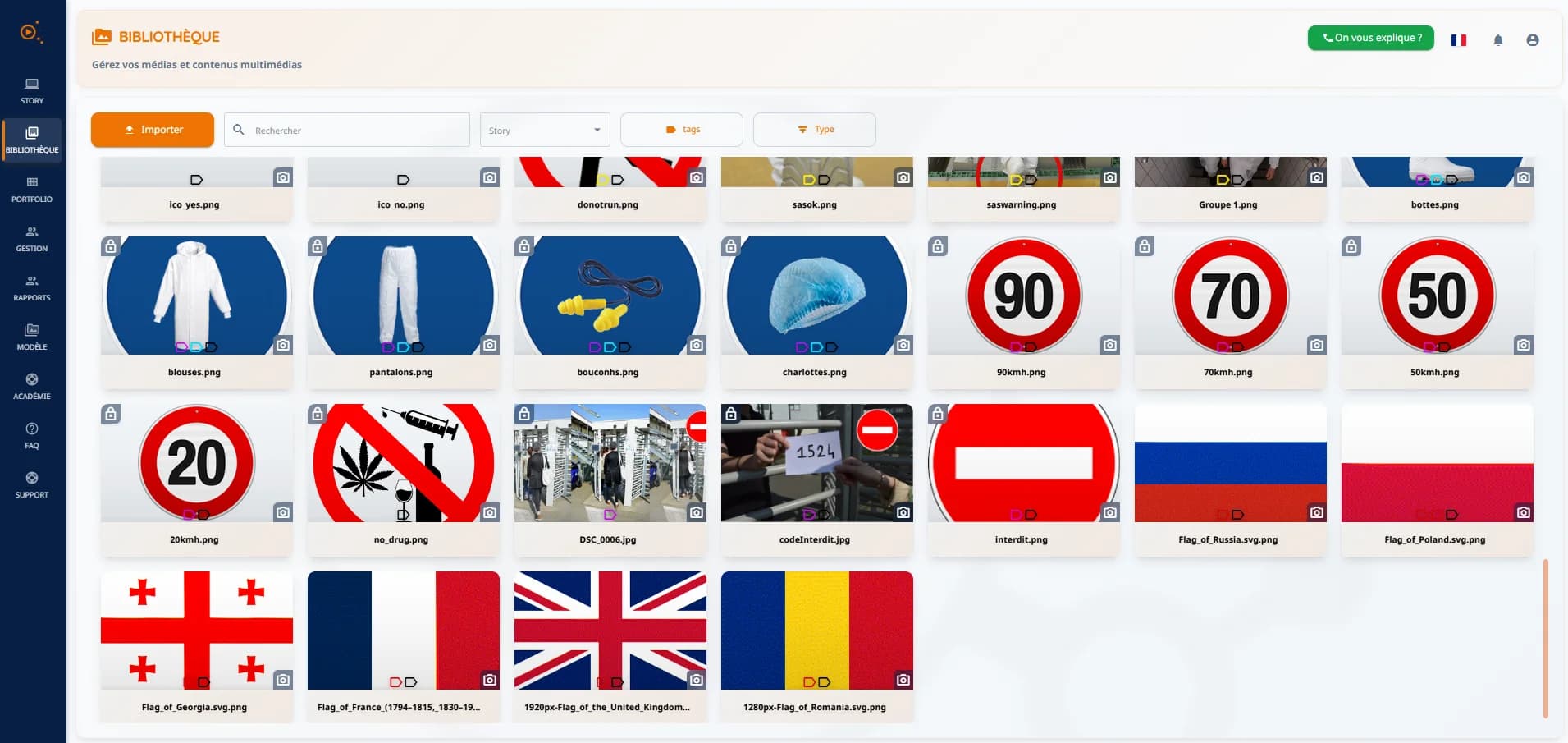
The CFMA Cooperl Training Center for Food Industry Professions welcomes hundreds of temporary workers each year, many of whom are non-native speakers. The challenge: training people in industrial safety who don't all speak the same language.
The 360° VR course created on easystory360 covers building navigation, hazard zone identification, station-specific safety instructions, PPE usage, and evacuation procedures. It is available in 9 languages thanks to the platform's native multilingual feature - no interpreter needed, no additional delay.
School bullying - Immersive awareness and co-creation
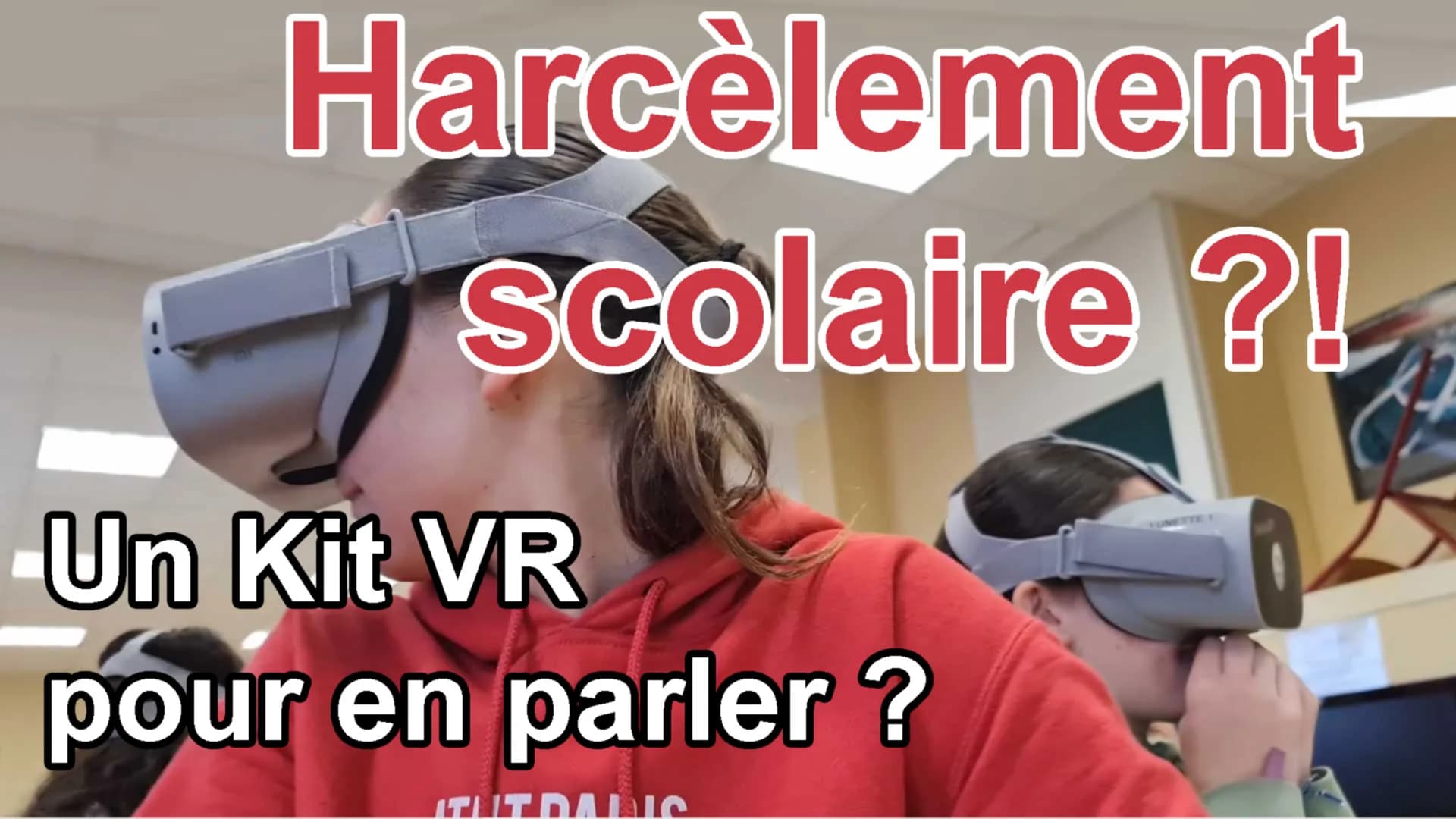
At Collège Saint-Yves La Salle in Saint-Brieuc, two 8th-grade students co-created a VR awareness film about school bullying with the explorations360 team. The experience immerses viewers at the heart of a bullying situation, leveraging VR's ability to generate empathy: headsets engage the right brain more - more visual and intuitive - which promotes emotional awareness.
This interactive approach will foster active learning and encourage students to reflect on different ways to resolve conflicts - paving the way for a genuine reusable "bullying educational toolkit" for other schools.
SUEZ - From video games to industrial education
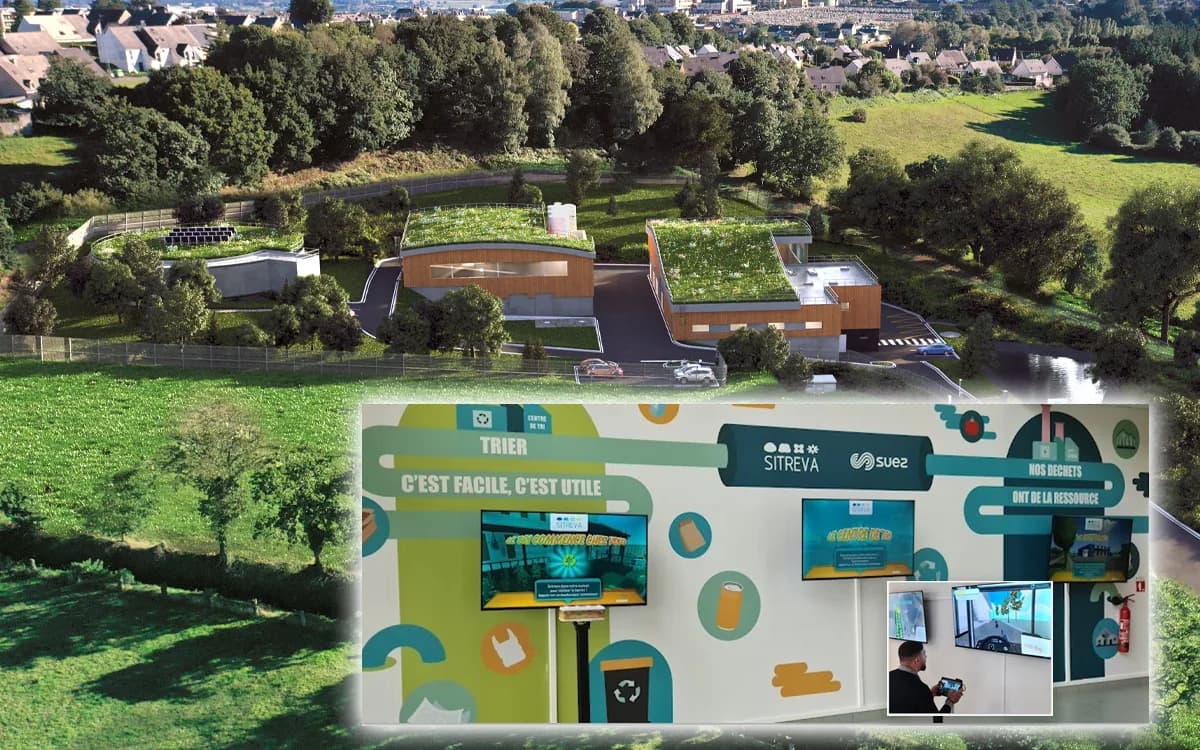
For SUEZ, gamification takes an unexpected form: playful digital workshops inspired by games like Temple Run or Sim City, adapted to convey key messages about waste sorting and energy recovery unit operations.
The setup combines individual virtual tours in VR headsets, shared experiences via the CUBE 360° (a collective immersive device controlled by tablet), and these gamified workshops. The goal: making accessible and understandable what is physically inaccessible - it's hard to enter a furnace that burns waste at 1,200°C, but in VR, no problem.
"Responsiveness, innovation, reliability, proactive solutions: more than a service provider, this team has become a trusted partner for us."
4. Create your gamified course in no-code
You don't need a developer to gamify 360° content. On easystory360, creating an interactive course is done with drag and drop.
Course design
- Quizzes: add multiple-choice questions directly in the 360° scene, with automatic scoring and immediate feedback.
- Conditional logic: define IF / OR / AND branches to adapt the course to the learner's responses.
- Interactive hotspots: place interaction points (text, image, video, link) in the environment, triggered by click or gaze.
- Scoring and progression: assign points per correct answer, display a final score, redirect to a remediation path if needed.
Measuring engagement
Gamification is useless without measurement. The easystory360 back-office provides detailed analytics:
- Completion rate for quizzes and the overall course
- Gaze heatmaps: where do users look the most?
- Hotspot clicks: which elements attract attention?
- Time spent per scene: identification of friction or interest zones
Take action
Gamify your training courses and awareness programs in just a few clicks.
Also discover VR training.
In summary
Immersive gamification is not about "adding a game" to 360° content. It's a shift in approach: the learner goes from spectator to active participant in their journey. Conditional logic, quizzes, escape games, and gaze-based interaction create a framework where every exploration is unique and every response has consequences.
The results are unambiguous: up to 86% retention in VR training, a satisfaction rating of 4.83/5 among VR learners (Lindner et al., 2025), and enhanced accessibility thanks to no-code and multilingual support.
This article is part of our comprehensive guide on spatial storytelling. Find the other pillars there - sensory design, spatial architecture - and the 5-step method to create your own immersive experiences.