
Discovering plankton through virtual reality is now an innovative educational approach that is transforming the way middle school students understand the marine world. By combining observation of living organisms, scientific materials, and digital immersion, this method makes organisms invisible to the naked eye visible and facilitates understanding of major issues such as biodiversity, oxygenation of the planet, and carbon capture.
Based on concrete feedback from an experiment conducted in the Alpes-Maritimes region, this article summarizes an interview with Arnaud Girola and shows how virtual reality is becoming a simple, effective, and accessible tool for teaching science.
“The tool is particularly interesting because it connects with the observation of living things. Children move back and forth between reality and animation: they recognize what they see in real life when they are immersed in the animation, and they also discover things they haven't seen before. This gives them a much more complete picture.”
Discovering plankton through virtual reality in schools
The use of virtual reality in middle schools is part of a specific educational framework, in collaboration with science teachers. The aim is not to replace scientific experimentation, but to enrich it. The sessions are built around a workshop dedicated to plankton, micro-organisms that are essential to marine life and climate balance.
Virtual reality allows us to transcend the physical limitations of the classroom. Students can observe highly detailed models of plankton species, understand their shapes, movements, and ecological roles. This immersive experience encourages curiosity, attention, and memorization, while remaining perfectly aligned with school curricula.
A hybrid teaching approach: real and virtual
The device is based on a deliberate alternation between two complementary approaches. On the one hand, students observe live plankton, collected locally, using binoculars. On the other hand, they use a VR headset to explore an immersive film showing species that are invisible during real observation.
This confrontation between reality and digital technology is central. What students see in the water, they can then recognize in the animation. And what they were unable to observe in real life, they discover through immersion. Virtual reality then becomes a logical extension of the scientific experience, rather than a mere technological gadget.
A scientific immersion to better understand plankton
A journey at the nanometer scale
The immersive film used in VR headsets offers simple and effective storytelling. Students find themselves aboard a small submarine that gradually descends into the ocean, while changing scale: from meters to centimeters, then millimeters, down to nanometers. This visual approach helps students understand orders of magnitude, which are often abstract for middle schoolers.
Each step reveals planktonic species in impressive detail. Textures, movements, and interactions are intuitively visible. Discovering plankton through virtual reality brings to life a world normally reserved for laboratory microscopes.
A deliberately short immersion period
Virtual reality immersion is limited to 10 or 20 minutes per session. The film lasts about 6 minutes, leaving time for discussion, observation, and hands-on activities. This educational choice prevents cognitive fatigue and reinforces the impact of the experience.
Virtual reality is therefore not used continuously, but at the right moment, as a trigger for understanding and discussion. This approach reassures teachers and easily adapts to the time constraints of science classes.
Interactive quizzes and student engagement
Learning through play with virtual reality
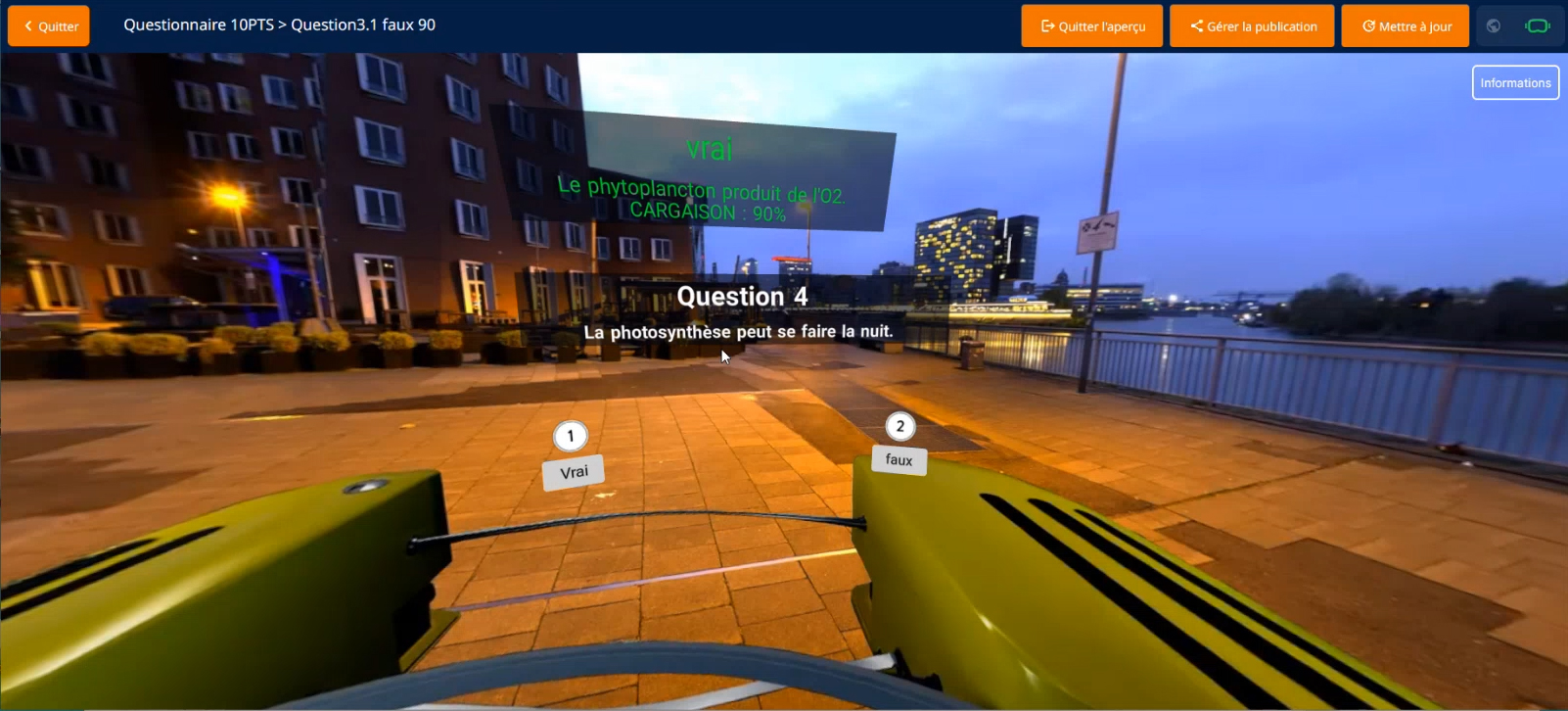
Beyond the immersive film, the explorations360 platform allows users to create interactive quizzes that are integrated into the VR experience. The principle is simple: students navigate through different 360° environments and answer questions related to plankton, its ecological role, and the threats it faces.
In the event of an error, the correct answer is explained immediately, which promotes active learning. The quizzes transform the session into a fun journey, similar to an educational mini-game, while remaining scientifically rigorous.
Adapt the level according to the audience
Another key advantage is the ability to tailor content to the audience. Thanks to language variants, used here as reading levels, vocabulary can be simplified or enriched depending on whether the audience consists of elementary school students, middle school students, or a more expert audience.
This flexibility is particularly useful during public events, educational forums, or workshops with small groups. Discovering plankton through virtual reality becomes a modular experience, capable of appealing to different profiles without having to completely recreate the content.
Why choose a simple VR solution like explorations360
For local authorities, teachers, and educational institutions, ease of use is an essential criterion. explorations360 stands out thanks to its quick start-up, intuitive control panel, and the ability to adapt the scenario in real time to suit the audience.
The platform does not promote a "fully virtual" approach. It is part of a comprehensive educational approach that respects life and traditional scientific methods. Virtual reality becomes a tool for meaning, not an end in itself.
In summary, discovering plankton through virtual reality offers a comprehensive, immersive, and balanced educational experience. It reinforces students' interest in science, facilitates understanding of complex concepts, and opens up new perspectives for environmental education, without unnecessary technical complexity.